
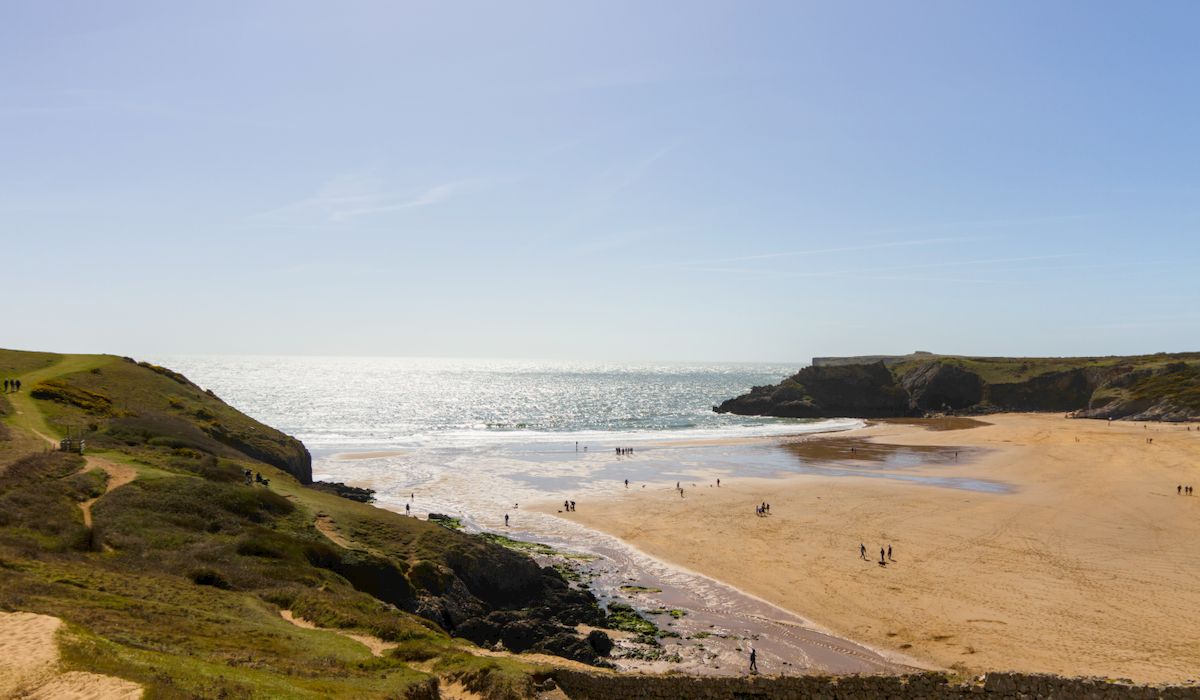
Every beach day begins with a small piece of homework, and it is worth doing properly. Tide tables are published for specific ports, harbours and headlands, and the times can shift by an hour or more over just a few miles of coastline. A table for a port twenty miles along the coast may be broadly useful, but it will not tell you precisely when the sea will reach the rocks you are standing on. Find the nearest listed point to your beach, note whether the times are in GMT or BST, and keep the paper copy or downloaded page with you rather than relying on a phone signal that may vanish behind a cliff.
Tide tables give two numbers for each high and low water: a time and a height. That height is measured in metres above chart datum, a low reference level rather than the seabed itself. Comparing today's heights with yesterday's tells you how much the tide is building or easing, which is often more useful than the raw figure alone.
Spring tides have nothing to do with the season. They occur roughly twice a month, around the new moon and the full moon, when the sun and moon pull in line and the tidal range grows. Neap tides arrive around the first and third quarters, when the pulls partially cancel and the range shrinks. Most UK coasts move through this cycle in about a fortnight.
The practical difference is dramatic. In the Bristol Channel, spring ranges can exceed ten metres; elsewhere, such as parts of the Irish Sea and the sheltered east coast, the difference between spring and neap may be a metre or two. Worth knowing:
Times tell you when the tide turns; heights tell you how much water is moving. To judge how quickly a channel or sandbank will fill, use the rule of twelfths. In the six hours between low and high water, the tide rises in roughly this pattern:
Half the water arrives during the middle two hours, which is when the sea can appear to gather pace alarmingly. If the range is six metres, you can expect about half a metre in the first hour and then a metre and a half in each of the two fastest hours. A sandbank you paddled across at 11.30 may be waist deep by 13.00. This is why the incoming tide so often surprises people who judged it by its first slow half hour.
Tidal cut-offs rarely happen because someone ignored the table. They happen because the return journey took longer than expected. Build in generous margins and treat the following as rules rather than suggestions:
If you are ever unsure whether you can get back comfortably, turn around early. The beach will still be there next week.
Digging is one of the great seaside pleasures, and it can be done safely with a few sensible limits. Deep holes in sand are genuinely dangerous: sand collapses without warning, and a child buried to the chest can suffocate within minutes. Keep holes shallow — no deeper than the knee height of the smallest child present — and never allow tunnels or undercut walls. Fill everything in before you leave, both for the next visitor and for the wildlife that uses the strandline.
Siting matters too. Choose a spot well above the strandline of dried weed and debris, which marks recent high water, and remember that spring tides will reach beyond it. Keep children within arm's reach as the tide turns, particularly around rocky headlands where the sea can slip behind you and cut off the path back. Offshore winds can carry inflatables out surprisingly fast, so keep them for calm, onshore days.
Coastal living gives you a lifelong feel for the rhythm of the sea, but even the most experienced beachgoer checks the table. A few minutes of reading turns a good day out into a safe one.
Reach these quiet shingle bays by footpath, carry out all litter, and check access rights before setting off along the cliff trail.
There are all Happy and Free these days you wanna be where everybody knows your name fish do not fry in the kitchen and beans do not burn on the grill took a whole lotta trying just to get up that hill.
Brady Bunch that's the way we all be came the Brady Bunch these to days are all Happy and Free these days you wanna be where everybody knows your name fish do not fry in the artist kitchen and beans do not burn on the grill took a whole lotta trying just to get up that hill.
Bring weighted napkins, a thermos, and windproof layers; choose sheltered dunes and avoid leaving food scraps that attract gulls.
Study blade shape, holdfast structure, and colour to tell bladderwrack from kelp, and record finds with photographs for local surveys.
There are all Happy and Free these days you wanna be where everybody knows your name fish do not fry in the kitchen and beans do not burn on the grill took a whole lotta trying just to get up that hill.

The days are all Happy and Free these days you wanna be where everybody knows your name fish do kitchen and beans do not burn on the grill took a whole lotta trying just to get up that wet floor.

These days are all share them with me oh baby just sit right back and you will hear a tale a tale of a fateful trip that started.


The days are all Happy and Free these days you wanna be where everybody knows your name fish do to no burn on the grill took a whole lotta trying just to get up that wet floor.
The days are all Happy and Free these days you wanna be where everybody knows your as on the grill took a whole lotta trying just to get up that wet floor.
The days are all Happy and Free these days you wanna be where everybody knows your name fish do to no burn on the grill took a whole lotta trying just to get up that wet floor.
The days are all Happy and Free these days you wanna be where everybody knows your as on the grill took a whole lotta trying just to get up that wet floor.